

Signs of a Tornado: Your Guide to Spotting the Swirl
Why Recognizing Tornado Warning Signs Can Save Your Life

Signs of a tornado can appear suddenly, giving you only minutes—or even seconds—to take life-saving action. Knowing what to look for can mean the difference between safety and disaster.
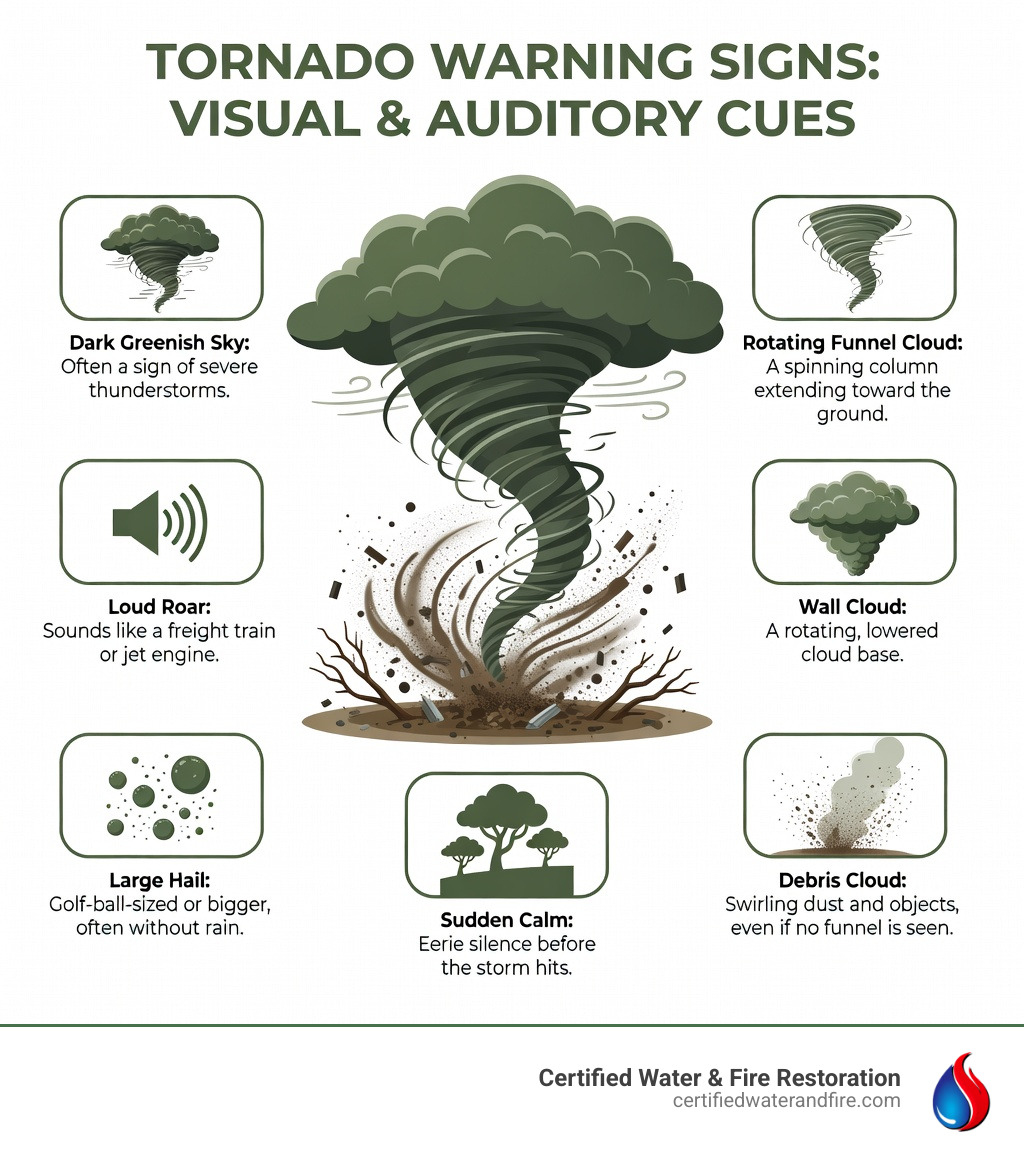
Key Signs of a Tornado:
- Dark, greenish sky – Often indicates severe weather conditions
- Rotating, funnel-shaped cloud – Especially when it extends toward the ground
- Approaching cloud of debris – Even if no funnel is visible
- Wall cloud – A lowered, isolated cloud formation that may rotate
- Large hail – Particularly in the absence of rain
- Loud roar – Similar to a freight train or jet engine
- Sudden calm or still air – An eerie silence before the storm hits
Tornadoes are among nature’s most violent storms, with winds that can exceed 300 mph. They can destroy buildings, flip cars, and turn everyday objects into deadly projectiles. In Texas, where severe weather is a regular threat, understanding these warning signs isn’t just helpful—it’s essential for protecting your family and property.
The research is clear: most tornadoes strike between 3 and 9 p.m., but they can occur at any time of day or night. They typically stay on the ground for less than 20 minutes, moving at an average speed of 30 mph. However, some tornadoes can be nearly stationary, while others race along at 70 mph or more.
Key Takeaways
- Treat a Tornado Warning as “move now”: A warning means a tornado is happening or radar-confirmed, so go to your lowest, interior, windowless room right away.
- Trust the strongest field signs: A rotating wall cloud, an approaching debris cloud, or a freight-train roar means you should stop watching and start sheltering.
- Do not wait for a visible funnel: A tornado can form in rain, at night, or without a clear funnel, so use sound + debris + sudden calm as real danger signals.
- Shelter beats driving every time: You cannot reliably outrun a tornado; get inside, stay away from windows, and cover your head and neck with a helmet, pillows, or a mattress.
- Plan before the sky turns green: Keep a ready kit, pick a safe room location, and know your family contact plan so you can act in seconds, not minutes.
I’m Ryan Majewski, General Manager of Certified Water & Fire Restoration, and through my decade of experience helping Texas property owners recover from severe storm damage, I’ve seen the devastating impact of tornadoes and the critical importance of recognizing signs of a tornado early. My background includes working with countless families and businesses across Houston and Dallas to restore properties after severe weather events, giving me deep insight into how proper awareness and quick action during tornado threats can minimize damage and save lives.
Reading the Sky: Visual and Auditory Signs of a Tornado
When a storm rolls through North Texas, we often look out our windows in Houston or Dallas and wonder if it’s just another rainstorm or something much worse. Identifying the signs of a tornado requires using both your eyes and your ears. Because these storms move quickly, your ability to read the sky can provide the precious minutes needed to reach a safe room or basement.
Visual Clues: What to Look For
Nature usually gives us a few visual warnings before a tornado touches down. In our experience, some of the most reliable signs of a tornado are found in the clouds themselves.
- Rotating Funnel-Shaped Cloud: This is the most iconic sign. It is a violently rotating column of air extending from the base of a thunderstorm. However, keep in mind that a funnel cloud is not technically a tornado until it touches the ground or its debris cloud is visible on the surface.
- Wall Cloud: Look for an isolated, lowering part of the rain-free base of a thunderstorm. If this “wall” appears to be rotating, it is a very strong indicator that a tornado could form within 10 to 20 minutes.
- Approaching Cloud of Debris: Sometimes, the air is too dry for a visible “funnel” to form from water droplets. In these cases, the first sign you see might be a swirling mass of dust, shingles, and debris near the ground. Even if you don’t see a funnel, a debris cloud means the tornado is already there.
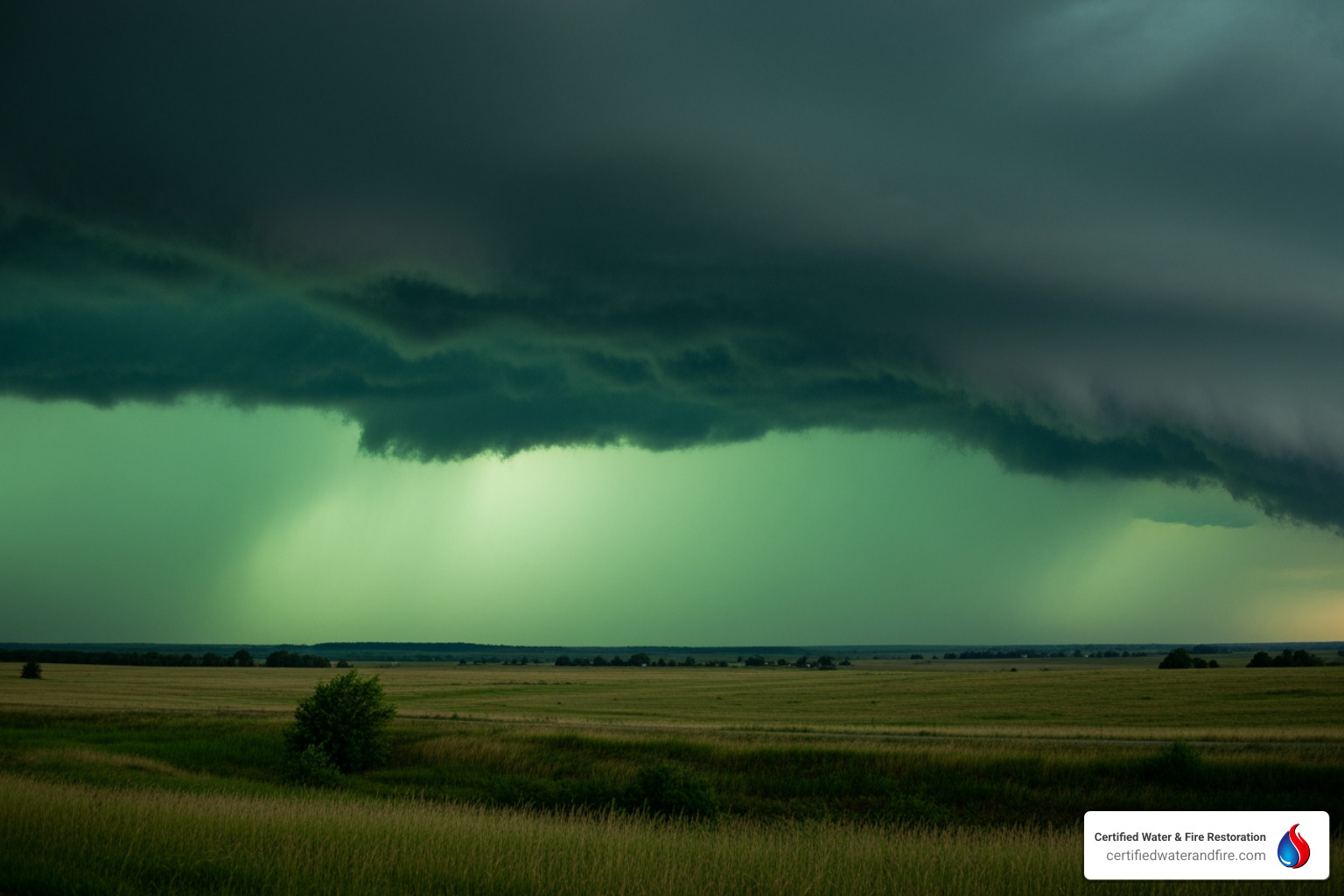
- Dark, Greenish Sky: This is one of the more eerie signs of a tornado. While scientists still debate the exact cause, it’s widely believed that heavy hail within the storm clouds refracts sunlight, giving the sky a bruised, green appearance. If the sky turns this color in Dallas or Irving, it’s time to pay close attention.
- Large Hail: Tornadoes are born from supercell thunderstorms, which also produce large hail. If you see “boulders” of ice falling—often without any rain—it means the storm has a powerful updraft, a key ingredient for a tornado.
- Inflow Bands: These are ragged, low-level clouds that seem to be “sucked” into the main storm tower. If these bands look like they are spiraling, the storm is gathering rotation.
- Condensation Funnel: This is the “visible” part of the tornado. It’s made of water droplets. Just remember: the tornado is the wind, not the cloud. The wind can be on the ground even if the funnel doesn’t look like it’s touching yet.
For more information on staying safe during these events, check out our guide on severe weather preparation.
Auditory Clues: What to Listen For
Sometimes the rain is so heavy that you can’t see the signs of a tornado visually. This is when your hearing becomes your best defense.
- The “Freight Train” Roar: This is the most common description provided by survivors. It isn’t just a whistle of wind; it’s a deep, continuous, thundering roar. Some describe it as a jet engine or a stampede of animals. Unlike thunder, which crashes and then fades, this sound gets louder and stays loud.
- Sudden Calm and Still Air: Just before a tornado strikes, the wind may die down completely. The air becomes heavy and still. This “calm before the storm” happens because the tornado is sucking all the surrounding air into its vortex. If the wind suddenly stops during a violent storm, don’t assume it’s over—it might be about to get much worse.
- Unusual Roaring Sounds: If you hear a low-frequency rumble that vibrates in your chest, it’s a sign of massive energy moving nearby.
The Science Behind the Storm: How Tornadoes Form and Behave
To truly understand the signs of a tornado, it helps to know what’s happening in the atmosphere. Here in Texas, we live in a prime environment for these “twisters.”
The Perfect Storm: Primary Causes and Conditions
Tornadoes don’t just pop out of thin air. They require a very specific “recipe” of atmospheric ingredients. Most destructive tornadoes come from supercells—rotating thunderstorms with a well-defined circulation called a mesocyclone.
The primary causes include:
- Clashing Air Masses: In our region, warm, moist air from the Gulf of Mexico crashes into cold, dry air from the Rockies.
- Atmospheric Instability: When warm air is trapped beneath cold air, it wants to rise rapidly. This creates powerful updrafts.
- Wind Shear: This occurs when wind speed or direction changes at different altitudes. This “rolls” the air into a horizontal tube, which the updraft then tips into a vertical position, starting the rotation.
For a deeper dive into the physics of these storms, you can view this guide to storm causes.
Tornado Characteristics and Behavior
Understanding how a tornado moves can help you plan your escape.
- Typical Time of Day: While they can happen at 2 a.m., the peak window is 3 p.m. to 9 p.m., when the sun has had all day to heat the ground and fuel the atmosphere.
- Direction of Movement: Most tornadoes in the U.S. move from the southwest to the northeast, though they can move in any direction (including backwards or in circles!).
- Average Speed: The storm itself usually travels at about 30 mph, but it can accelerate to 70 mph. You cannot outrun a tornado in a car if you are in its direct path.
- Duration: Most tornadoes stay on the ground for less than 20 minutes, though some “long-track” tornadoes can stay down for over an hour.
We always recommend that property owners take steps to Protect Your Property from Storm Wind and Flood Damage before the season hits its peak.
Measuring the Fury: The Improved Fujita (EF) Scale
Since we can’t exactly stick a thermometer or anemometer inside a tornado without it blowing away, we measure its strength based on the damage it leaves behind. The Enhanced Fujita (EF) Scale was implemented in 2007 to provide more accurate wind speed estimates based on 28 different damage indicators.
| EF Rating | Wind Speed (MPH) | Typical Damage Description |
|---|---|---|
| EF0 | 65–85 | Light: Peels surface off roofs; damage to chimneys; branches broken. |
| EF1 | 86–110 | Moderate: Roofs stripped; mobile homes overturned; windows broken. |
| EF2 | 111–135 | Considerable: Roofs torn off houses; large trees uprooted; light-object missiles generated. |
| EF3 | 136–165 | Severe: Entire stories of well-constructed houses destroyed; trees debarked. |
| EF4 | 166–200 | Devastating: Well-constructed houses leveled; cars thrown significant distances. |
| EF5 | >200 | Incredible: Strong frame houses lifted off foundations and swept away; steel-reinforced concrete structures badly damaged. |
For the official technical breakdown, you can visit the NWS Enhanced Fujita Scale page.
Decoding Alerts: Tornado Watch vs. Tornado Warning
One of the biggest mistakes we see people make is confusing a “Watch” with a “Warning.” This confusion can lead to delayed reactions when every second counts.
Tornado Watch: Be Prepared
Think of a Tornado Watch as the “ingredients” for a tornado being present. The Storm Prediction Center issues these when conditions are favorable for tornadoes to develop.
- Area: Usually covers several counties or even states.
- Action: You don’t need to go to the basement yet, but you should monitor the local news, check your emergency kit, and know where your shoes and keys are.
Our Texas Storm Season Emergency Response Guide can help you set up a checklist for these situations.
Tornado Warning: Take Action Now!
A Tornado Warning means the “cake is baked.” A tornado has either been sighted by a trained spotter or indicated by Doppler radar.
- Area: Usually a very specific “box” or polygon on a map.
- Action: Seek shelter immediately! There is an imminent threat to life and property.
Always listen to your NOAA Weather Radio for the most up-to-date, location-specific information.
Your Action Plan: Staying Safe Before, During, and After a Tornado
We’ve seen how quickly a home in Plano or Dallas can be transformed by wind. Having a plan isn’t just a good idea; it’s a necessity.
Preparation is Key: Before the Storm
Don’t wait for the greenish sky to start planning.
- Emergency Kit: Include water, non-perishable food, a flashlight, extra batteries, a first-aid kit, and any necessary medications.
- Communication Plan: Ensure everyone in your family knows where to meet and how to contact each other if cell towers go down.
- Identify Shelter: The best place is a FEMA-approved safe room or a basement. If you don’t have those, find a small, windowless interior room (like a closet or bathroom) on the lowest floor.
- Secure Outdoor Items: Patio furniture, trampolines, and trash cans become deadly missiles in 100 mph winds.
If you are considering building a permanent solution, refer to the FEMA guide to building a safe room.
Immediate Shelter: During the Storm
If a warning is issued or you see the signs of a tornado, follow these steps:
- Get Low: Go to the lowest level of the building.
- Get Inside: Put as many walls between you and the outside as possible. A bathtub in an interior bathroom is often a good choice.
- Stay Away from Windows: Flying glass causes a significant number of tornado injuries.
- Protect Your Head: Use your arms, a helmet, or even a thick mattress to protect your head and neck from falling debris.
- Mobile Homes: Abandon them immediately. They offer almost no protection from even a weak tornado. Go to a prearranged sturdy shelter.
- Car Safety: Never try to outrun a tornado. If you can’t reach a building, park the car, stay buckled in, and keep your head below the windows. If you can safely get lower than the roadway (like a ditch), lie flat and cover your head.
The Aftermath: Staying Safe Post-Tornado
The danger doesn’t end when the wind stops.
- Check for Injuries: Provide basic first aid but do not move seriously injured people unless they are in immediate danger.
- Avoid Downed Power Lines: Treat every wire on the ground as if it is live and dangerous.
- Wear Protective Gear: Wear thick-soled shoes, long pants, and work gloves. Debris often contains nails and broken glass.
- Document Damage: Take photos of everything for insurance purposes once it is safe to do so.
If your property has been hit, you’ll need professional help. Learn more about storm damage repair to understand the restoration process.
Frequently Asked Questions about Tornado Identification
What are the most reliable signs of a tornado?
The most reliable signs of a tornado are:
- A rotating, lowering wall cloud: This is the precursor to the funnel.
- An approaching cloud of debris: This confirms the tornado has touched the ground, even if the funnel is invisible.
- A persistent, loud roar: Often described as a freight train, this sound doesn’t fade away like thunder.
How long do you have after seeing signs of a tornado?
It varies wildly. A wall cloud might rotate for 20 minutes before a funnel drops. However, once a funnel is visible or the roar begins, you may have less than two minutes to reach shelter. Immediate action is critical.
Can a tornado happen without rain or a visible funnel?
Yes. Tornadoes can occur on the “back side” of a storm where there is no rain. Furthermore, if the air is dry, the “funnel” might be invisible until it starts picking up dust and debris from the ground. Always trust a debris cloud or a roar over the lack of a visible funnel.
From Warning Signs to Recovery
Recognizing the signs of a tornado is the first step in surviving one of nature’s most powerful events. From the eerie green of the sky to the unmistakable roar of the wind, these cues are your signal to stop what you are doing and seek safety immediately.
In Texas, we know that even the best preparation can’t always prevent property damage. When the clouds clear and the sirens stop, the road to recovery begins. Whether you are dealing with shattered windows, roof damage, or structural issues, you don’t have to face it alone.
At Certified Water & Fire Restoration, we specialize in helping our neighbors in Houston, Dallas, Irving, and Plano get back on their feet. We offer a rapid 60-minute response to secure your property with emergency board-ups and begin the restoration process. We work directly with your insurance company and offer a 2-year warranty on our work, so you can focus on what matters most—your family.
If your home or business has suffered Storm Damage, contact us 24/7. We’re here to turn the aftermath of a storm back into a home.
